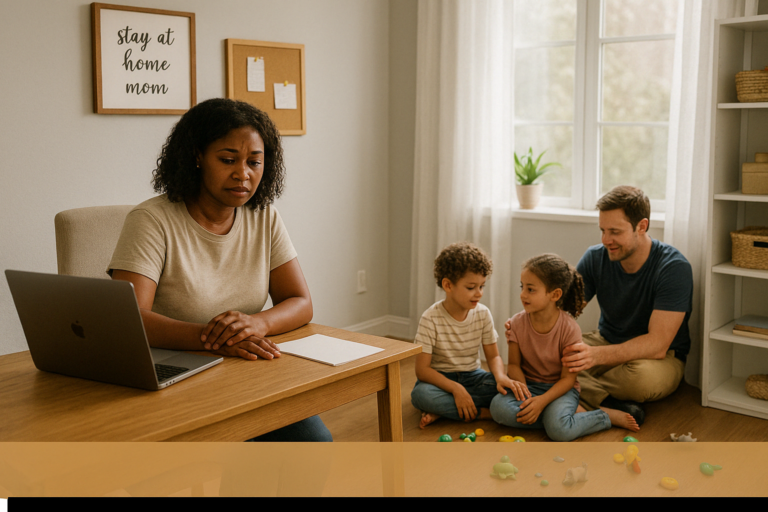

There was this moment in our second year of marriage when I looked up from my phone during dinner and realized my husband and I hadn’t spoken a word to each other in over twenty minutes. The only sounds were the gentle hum of the air conditioning and the occasional “ding” of WhatsApp notifications. I looked up at him, this man I had promised to love and cherish, and realized we hadn’t had a real conversation in weeks. We had become expert roommates dealing with serious marriage connection problems.
This is not uncommon for couples, and marriage connection problems are one of those realities that nobody warns you about during pre-marital counseling. Unfortunately, this was just the beginning of what I now call our “silent season.”
How We Got Here (And How You Might Too)
The drift didn’t happen overnight. It started innocently enough with:
The Work Takeover – My husband’s new job meant longer hours, and suddenly our evening gist sessions became brief status updates. “How was work?” “Fine.” “Okay.” End of conversation. I thought he was just tired, but weeks turned into months of this pattern.
The Phone Invasion – Without realizing it, we had both developed what I call “phone reflex disorder.” Any quiet moment was immediately filled with scrolling. Instead of asking, “How are you feeling about your presentation tomorrow?” I was checking Instagram stories of people I barely knew. These marriage connection problems were becoming our new normal.
The Assumption Game – We started assuming we knew what the other person was thinking. After all, we lived together, so surely we were still connected, right? Wrong. We were like two people living in the same house but on different planets, struggling with marriage connection problems that we didn’t even recognize.
After about three months of this polite coexistence, we had our first real argument in months. And you know what? It felt almost refreshing because at least we were talking! That’s when I realized we had a problem that required immediate intervention.
Read Next: 7 Effective Communication Styles to Enhance Marriage
The “Aha!” Moment
During one of our Sunday afternoon rice and stew lunches, I decided to conduct a little experiment. I put my phone in the bedroom and asked him to do the same. For the first ten minutes, we just sat there looking at each other like two people who had just met. It was both awkward and hilarious.
“So,” I said, “tell me something I don’t know about your week.”
He paused, spoon halfway to his mouth, and said, “You know what? I actually can’t remember the last time someone asked me that.”
That conversation lasted two hours. We talked about his fears regarding his new role and my frustration with a difficult student, and even laughed about how we had become those couples we used to pity. By the end of it, I felt like I was reconnecting with my best friend.
What We Learned About Marriage Connection Problems (The Hard Way)
Connection Requires Intention – Love doesn’t automatically translate to communication. Just because you share a bed doesn’t mean you’re sharing your lives. We had to deliberately create space for real conversation to solve our marriage connection problems.
Small Talk Isn’t Small – Those “How was your day?” questions we had dismissed as meaningless were actually the foundation of emotional intimacy. We learned to ask better questions: “What was the most challenging part of your day?” “What made you smile today?” “What are you looking forward to tomorrow?”
Phone-Free Zones Are Life-Savers – We established what we called “device detox” times. No phones during meals, no scrolling in bed before sleep, and definitely no phones during our evening walks. Initially, it felt like we were missing a limb, but gradually, we started having the kinds of conversations that made us fall in love in the first place.
The Power of Shared Activities – We rediscovered activities we both enjoyed. Sunday evening movie nights (with actual discussion after), cooking together (which often ended in him eating half his dinner from the cooking pot), and taking those after-dinner walks around our neighborhood while gossiping about the neighbors.
Overcoming Marriage Connection Problems: Practical Steps That Work
The 20-Minute Rule – Every evening, we spend at least 20 minutes talking without distractions. Sometimes it’s deep conversation about dreams and fears, sometimes it’s arguing about whether Chelsea will ever win the Premier League again. The topic doesn’t matter; the consistency does.
The Weekly Check-In – Every Friday evening, we ask each other: “How are we doing as a couple?” It sounds formal, but it helps us address small issues before they become big problems. Plus, it often leads to planning exciting things for the weekend.
Text Less, Talk More – We stopped using WhatsApp to discuss important matters. If it matters, we save it for face-to-face conversation. Texting became for quick logistics: “Should I pick up bread?” not “I’m upset about what happened yesterday.”
The Gratitude Practice – Before bed, we share one thing we appreciated about each other that day. Even on days when we wanted to strangle each other, this practice reminded us why we chose each other.
When Progress Feels Slow
Some days, the conversation still feels forced. Some weeks, we slip back into our old patterns of parallel living. The difference now is that we recognize it quickly and course-correct. We’ve learned that building communication skills in marriage is like building muscles at the gym – it requires consistent effort, and you have to keep showing up even when you don’t feel like it.
One evening, about six months into our intentional communication journey, my husband looked up from his book and said, “I was just thinking about how much I’ve missed talking to you.” That’s when I knew we were on the right track.
The Beautiful Truth
Marriage is full of seasons. There will be seasons of deep connection and seasons where you feel like strangers. The goal isn’t to avoid the difficult seasons but to learn how to navigate them together. Sometimes the most profound intimacy comes from the simple act of putting down your phone, looking into your spouse’s eyes, and asking, “How are you really doing?”
Our silent season taught us that love isn’t just a feeling – it’s a daily choice to stay curious about the person you married. Because the truth is, we’re all constantly growing and changing. The spouse you married five years ago isn’t exactly the same person sleeping next to you tonight. And that’s not a problem to solve; it’s an adventure to embrace.
After all, if you’re going to be stuck in Lagos traffic together for the next 40 years, you might as well have something interesting to talk about!